
Career Readiness in the AI Era: Skills You Can't Ignore Anymore
The landscape of work is undergoing a seismic shift, driven primarily by the rapid advancement of Artificial Intelligence (AI). What was once science fiction is now an integral part of nearly every industry, automating tasks and reshaping job roles. For professionals and job seekers today, career readiness is no longer about mastering traditional skills alone; it's about adapting to and thriving alongside AI. Ignoring this change is a fast track to irrelevance.
This blog post outlines the essential skills and mindsets you must cultivate to ensure your career not only survives but excels in the age of AI.
1. The Foundation: Technical Literacy
While you don't need to build AI models, a basic understanding of how systems work is critical for digital literacy.
Understanding AI Fundamentals
You need to know what ML, NLP, and Deep Learning are, and how they are currently being applied in your industry. This isn't about coding; it's about context.
- Data Fluency: how data is collected, cleaned, and used to train AI models. This tools is integral data insights and is more valuable than your ability to manually generate reports.
- Prompt Engineering: The art of formulating prompts to extract the desired output from AI models like Large Language Models or image generators. Knowing how to ask the right questions is the difference between an average and highly productive worker.
- Tool Integration: Being comfortable with the AI tools and software being integrated into your daily workflow, such as automated coding assistants, AI powered customer service platforms, or predictive analytics software.
2. The Human Advantage: Essential Soft Skills
As AI takes over routine analytical tasks, the value of uniquely human capabilities rises. These soft skills are the core competencies that AI cannot replicate yet.
| Soft Category | Description | Importance Level |
|---|---|---|
| Critical Thinking | Ability to evaluate AI outcomes for bias, errors, and logic to make sound judgments, especially when data is incomplete or conflicting. | High |
| Emotional Intelligence (EQ) | Managing teams, building relationships, understanding human motivators, client relationship, and client relationship management. | Critical |
| Creativity & Innovation | Envisioning novel solutions, creative concepts, and original concepts. | High |
| Collaboration | Working effectively in hybrid human-AI teams. | Essential |
| Adaptability & Resilience | Quickly adjusting to new technologies and changes. | Critical |
3. The Future: AI-Specific Competencies
Beyond basic literacy, certain skills will define the leaders of the AI-powered workforce.
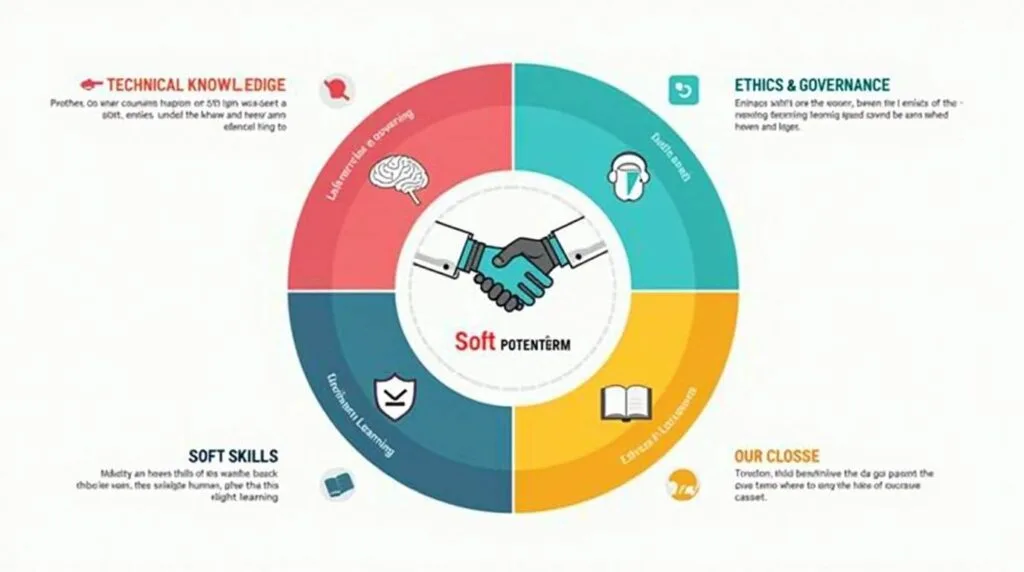
AI Ethics and Governance
As AI becomes more powerful, ethical considerations are highly critical. Professionals must understand the biases inherent in data, the implications of automated decision-making, and the regulatory landscape surrounding AI technology.
- Identifying Bias: Recognizing where algorithms might make unfair decisions due to flawed training data.
- Privacy and Security: Understanding the risks associated with data sharing, especially when working with proprietary or customer data.
- Responsible Deployment: Advocating for the fair and transparent use of AI tools in your organization.
Complex Problem-Solving
The problems left for humans will be the truly complex, multi-faceted ones—the "wicked problems" that require synthesizing information from various domains, understanding human behavior, and applying intuition that AI cannot replicate.
AI tools excel in narrow tasks; humans excel in systems thinking. Understanding how different parts of a system interact and how to apply AI to solve complex system-level problems will be a key differentiator.
4. Lifelong Learning: A Career Imperative
The pace of technological change means that formal education alone is insufficient. Lifelong learning is no longer a benefit; it is a prerequisite for survival.
To stay relevant, commit to continuous upskilling. This can involve:
- Online courses and certifications focused on AI and emerging technologies.
- Joining professional networks and communities focused on emerging tech fields.
- Active working on projects that require learning new AI tools and methodologies to achieve your current role.
Action Plan for Upskilling
We encourage everyone to commit to at least one new learning opportunity this quarter.
| Learning Focus | Recommended Action | Timeline |
|---|---|---|
| AI Literacy | Complete an introductory course on AI/ML principles. | Q1 |
| Prompt Engineering | Attend a workshop or self-study best practices for LLMs. | Calendar event |
| Ethics & AI | Read a book or paper on AI ethics and discuss with a colleague. | Next 60 days |